blog · March 16, 2026
From 1.85 Billion to 4.7 Billion: How Homi Kharas Predicted the Rise of the Global Middle Class
By World Data Lab
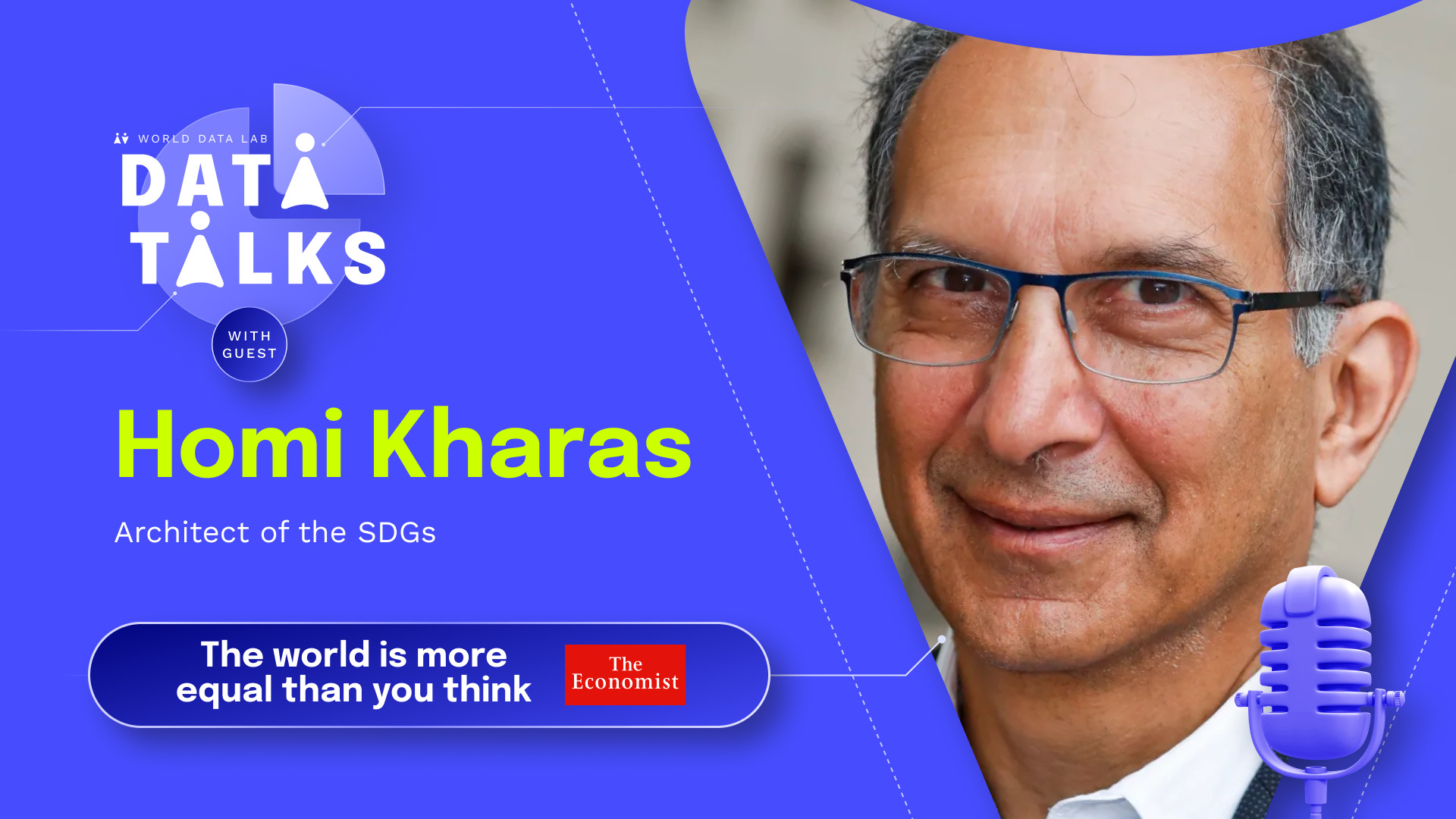
In 2009, at the height of the financial crisis, Homi Kharas published a landmark paper forecasting a rapidly growing global middle class led by Asia. Seventeen years later, the projection has held up remarkably well.
In 2009 — the height of the global financial crisis — most economists had their eyes fixed on a collapsing Western middle class. One researcher was looking east. Homi Kharas, co-founder of World Data Lab and a globally recognised authority on the middle class, published a landmark paper with the OECD that shifted how the world thinks about consumer growth. Seventeen years later, the forecasts have held up remarkably well.
When Kharas began his research, the conventional narrative was one of Western decline. The American and European middle class, long the engine of global consumer spending, was under severe strain. But Kharas had spent years working in East Asia, where rapid growth was building a new consumer base from a low starting point.
"I wanted to do a simple experiment to see how much of East Asia's growth could offset and mitigate the reduction in growth happening in the United States and Europe," Kharas explains. His conclusion pointed to a long-term shift in the global economy's centre of gravity away from the West and toward Asia, accelerated by China's accession to the WTO in 2001.
At the time of publication, Kharas estimated 1.85 billion people belonged to the global middle class and projected the figure would reach roughly 3.25 billion by 2020. The actual count, as later calculated by World Data Lab, was 3.4 billion — slightly above the original forecast. The 2030 projection originally stood at 4.9 billion; WDL now forecasts 4.7 billion, a gap of around 200 million attributable largely to COVID-19. For a forecast made over a decade in advance, the margin is remarkably narrow.
The middle class is where economic activity concentrates. According to Kharas, the global middle class accounts for around 60% of all consumer spending, with the affluent contributing roughly a third. Together, they dominate global consumption. Understanding this group — where they live, how old they are, what they spend on — is foundational to understanding the direction of the global economy.
WDL's methodology draws on household survey data, geospatial satellite imagery and large-scale open datasets. Survey data tends to under-represent the tails of the income distribution, so multiple data streams are used to validate and calibrate the models — a continuously updated, globally consistent dataset that improves with every iteration.
One area where this empirical approach is especially valuable is climate emissions forecasting. Many models rely on government commitments and policy pledges; WDL measures what is actually being implemented. "We use that to make our forecasts rather than just the promises of what people say they're going to do," Kharas notes — a distinction with significant implications for investment strategy, policy planning and business risk assessment.
After seventeen years of tracked forecasts and continuous model refinement, World Data Lab's methodology has demonstrated a rare quality in economics: it works. Not because the future is predetermined, but because the right signals — demographics, structural growth, urbanisation — move slowly enough to be measured, modelled and trusted.