blog · August 4, 2026
An uneven boom: Tracking the varied trajectories of Africa's future youth labor markets
By Ivy Nyayieka
Africa will add over 200 million young people by 2040 — but just ten countries will generate nearly two thirds of that growth. New projections from the Africa Youth Employment Clock show exactly where the pressure to create jobs will be greatest.
Africa will add over 200 million young people by 2040, heightening the need to create pathways into employment. Yet treating the continent as one uniform labor market overlooks significant shifts happening within its borders. Projections from the Africa Youth Employment Clock reveal that Africa's youth boom is not evenly distributed, with just ten countries expected to generate nearly two thirds of the continent's total youth population growth, pinpointing exactly where the pressure to create jobs to harness the future workforce will be greatest over the next fifteen years.
Here is a breakdown of where youth populations are expanding, where growth is slowing, and what these shifts mean for the future of work:
Niger leads as West and Eastern African youth labor pools expand
The nations climbing the ranks most rapidly are concentrated in the West African Economic and Monetary Union, led by Niger, Mali, Benin and Togo, with the region serving as a primary growth engine for future labor. However, Niger, Mali and Burkina Faso, which are projected to account for 61 percent of the entire youth population added to the WAEMU region, face severe security crises, putting this major future workforce at risk. While these nations are the biggest drivers of new potential labor, escalating violence threatens workforce development, having already displaced nearly 2.1 million people in Burkina Faso alone while forcing 14,800 schools to close across Mali, Burkina Faso and Niger.
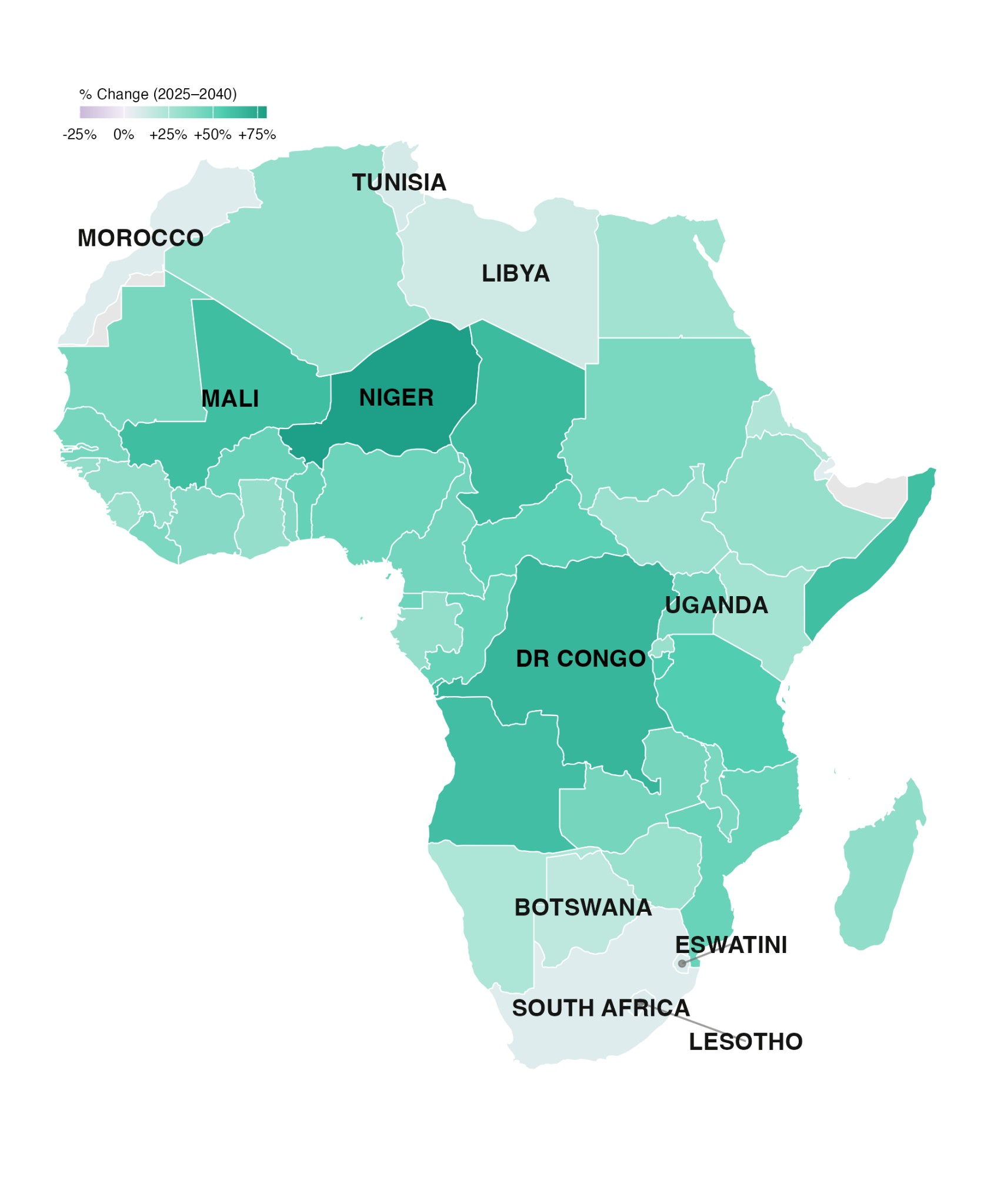
Niger, which has one of the highest fertility rates in the world partly attributable to a high prevalence of child marriage and early pregnancy, is the fastest climber on the continent, surging five places to become the thirteenth largest youth population with a projected growth of 79 percent by 2040. Eastern Africa is also experiencing rapid expansion, with Uganda set to overtake South Africa for sixth place. The Democratic Republic of the Congo in Central Africa will also grow its youth workforce by 67 percent to surpass Egypt for the third largest spot.
Youth population growth slows across Northern and Southern Africa
Countries in Northern and Southern Africa, two regions where fertility began decreasing much earlier and faster than in the rest of Africa, are anticipating a much slower expansion of their potential youthful workforce. North African nations such as Morocco, Tunisia and Libya and Southern African countries such as South Africa, Lesotho, Eswatini and Botswana are expected to see very modest growth in new young labor market entrants. As this future labor supply lags behind the surging growth seen elsewhere on the continent, these nations are slipping down the regional demographic rankings, with South Africa projected to fall from sixth to ninth place by 2040, Morocco dropping five spots to nineteenth and Libya slipping three places down the demographic charts.
Island nations face shrinking youth labor markets
At the bottom of the growth charts, island countries are experiencing negative youth workforce trajectories. Between 2025 and 2040, the youth population in Mauritius will shrink by roughly 23 percent, and Cabo Verde will face a 10 percent drop. The youth populations are shrinking because these island nations have reached a critical turning point where fertility rates are falling below their replacement levels, that is, the total fertility rate needed to maintain the population at a constant size, as their broader populations are actively aging.
What this means for programs: unlocking the potential of a quarter of the future global workforce
Set against a backdrop of population decline in the rest of the world, the surging youth demographic in Africa provides a massive global advantage. By 2050, the continent will supply a quarter of the global workforce. However, because this growth is unevenly distributed, development stakeholders must tailor their interventions to match specific labor market realities:
- For rapidly growing nations: In West, Central, and Eastern Africa, the high volume of new labor market entrants requires job creation at scale. However, this demographic surge is colliding with a highly undiversified youth labor market, typical of early stage demographic economies that suffer from low productivity, weak technological upgrading, and a reliance on unprocessed goods for their exports. Data from the WAEMU region shows that agriculture absorbs over 71 percent of the youth workforce in Niger, roughly 60 percent in Mali, and nearly 50 percent in Burkina Faso. Because more than half of the youth workforce is employed in agriculture, the data shows there is an opportunity for stakeholders to target the youth with investments that do two things: actively diversify youth employment into new sectors, and critically, upgrade existing agricultural roles into higher value agribusiness. In Niger, for instance, the government is leveraging a new World Bank Country Partnership Framework to stimulate job creation by building infrastructure specifically in modern agribusiness. Togo has upgraded rural roles by integrating youth into higher value agricultural chains through a government agribusiness program that created over 840,000 seasonal jobs by 2025. In Eastern Africa, Uganda is utilizing programs like the Sustainable Inclusive Youth Employment Pathways to connect young people with modern farming skills. On the diversification front, meanwhile, Mali is actively developing its technology space through investments from the International Finance Corporation and Orange Mali, expanding internet networks to empower more women to join the digital economy. Benin is promoting technological upgrading through its National Youth Employment Strategy, which funds entrepreneurship in the digital economy and agriculture via microfinance loans.
- For slowing nations: Countries in Northern and Southern Africa have a limited window of time to reap their economic potential before their populations age further. To survive this demographic shift and offset a shrinking labor pool, the data points to a need for these aging nations to bring marginalized groups into employment. In Northern Africa, 31% of young women are Not in Education, Employment or Training (NEET), the highest share on the continent, yet nearly one in three of these NEET young women already hold a tertiary degree, well above the average for African youth of about 9%. These regions have an opportunity to unlock the potential of women by relieving the heavy unpaid care responsibilities that currently keep them out of the workforce. The scale of this burden is staggering in Northern Africa, where women in Egypt spend over nine times as many minutes per day on unpaid care as men, while women in Tunisia and Morocco spend about eight and seven times as much, respectively. Furthermore, to fully sustain economic growth, the United Nations advises leveraging automation and new technologies to boost productivity across all age groups. Alongside these broad structural shifts, programs must urgently align education with private sector demands to upskill the remaining youth. Morocco, for example, is using a 450 million dollar Employability and Land Compact to modernize its skills system by upgrading fifteen vocational training centers focused on market relevant sectors. Similarly, Tunisia has made attempts to tackle educated youth unemployment by allowing university students to graduate with a business plan instead of following the standard curriculum, leading to higher rates of self employment.
- For shrinking island nations: As their youth populations contract and their overall populations age, nations like Mauritius and Cabo Verde face a different challenge. Stakeholders have the opportunity to implement targeted strategies to offset the shrinking labor pool. By taking advantage of the rapid youth population growth in other African nations where high shares of young people are not in employment, education or training (NEET), these countries can simplify immigration procedures to absorb surplus regional talent. For example, the Democratic Republic of the Congo, Mali and Angola are anticipating youth population increases of over 62 percent by 2040, yet all three record youth NEET rates above the 19 percent African average, peaking at 25 percent in the Democratic Republic of the Congo. Alongside this regional integration, actively dismantling the barriers that keep women out of employment, education and training through investments such as affordable childcare remains a critical opportunity. In Mauritius, for instance, the NEET rate for young women sits at 17 percent compared to 11 percent for young men.
With the African youth population projected to continuously expand through the 2070s, the continent holds the future of the global workforce. To turn this unprecedented growth into a true economic dividend, stakeholders must urgently match demographic momentum with targeted investments in education, modern agribusiness and female inclusion. Ultimately, surplus youth talent is a powerful global asset waiting to be unlocked.