blog · September 2026
Middle Class Growth and Financial Health in ASEAN: A focus on Indonesia & Vietnam
By Wolfgang Fengler, Reshma Sheoraj & Tedi Yankov
ASEAN's next middle-class wave will be shaped by Indonesia and Vietnam, two large markets with very different financial health profiles.
Executive Summary
This briefing note is prepared by World Data Lab (WDL) for Jon Huntsman (Vice Chairman & President, Strategic Growth, Mastercard). It examines the rapid expansion of ASEAN's middle class and what this means for financial health and inclusive growth, with a particular focus on Indonesia and Vietnam. The note uses WDL demographic and consumer spending data to identify the affordability thresholds at which different dimensions of financial health access become attainable, highlighting a significant opportunity to move the region's next generation of consumers from basic financial access toward greater resilience. The main messages from the insights are set out below.
5 main messages:
- In 2026, ASEAN's middle class reached 373 million people - bigger than any country's middle class in APAC, except China (1B middle class) and India (670M middle class).
- ASEAN adds about 12 million new middle-class adults every year on average, reaching 500 million by 2037. WDL projects that by 2036 ASEAN's middle class will reach 492m, adding 120M.
- 3 countries are driving this growth: Indonesia (129M middle class in 2026, adding 54M by 2036), Vietnam (71M middle class in 2026, adding 20M by 2036), and the Philippines (57M middle class in 2026, adding 32M by 2036).
- Indonesia is ASEAN's biggest opportunity: 73% of adults use the internet, but only 19% pay digitally in stores. Indonesia becomes a majority consumer-class country in 2027, adding 54 million consumers by 2036.
- Vietnam shows what's possible: 74% of adults are already consumer class, and 67% pay digitally in stores. But 44% still worry most about medical costs.
1. ASEAN
Key section takeaways
- Over half of ASEAN's¹ 700m total population is now in the middle class² with 373m people strong. WDL projects that by 2036 ASEAN's middle class will reach 492m, adding 120M.
- Three countries are driving this rise and account for 89% of ASEAN middle class growth: Indonesia (+54M), Philippines (+32M) and Vietnam (+20M) and are the growth engine
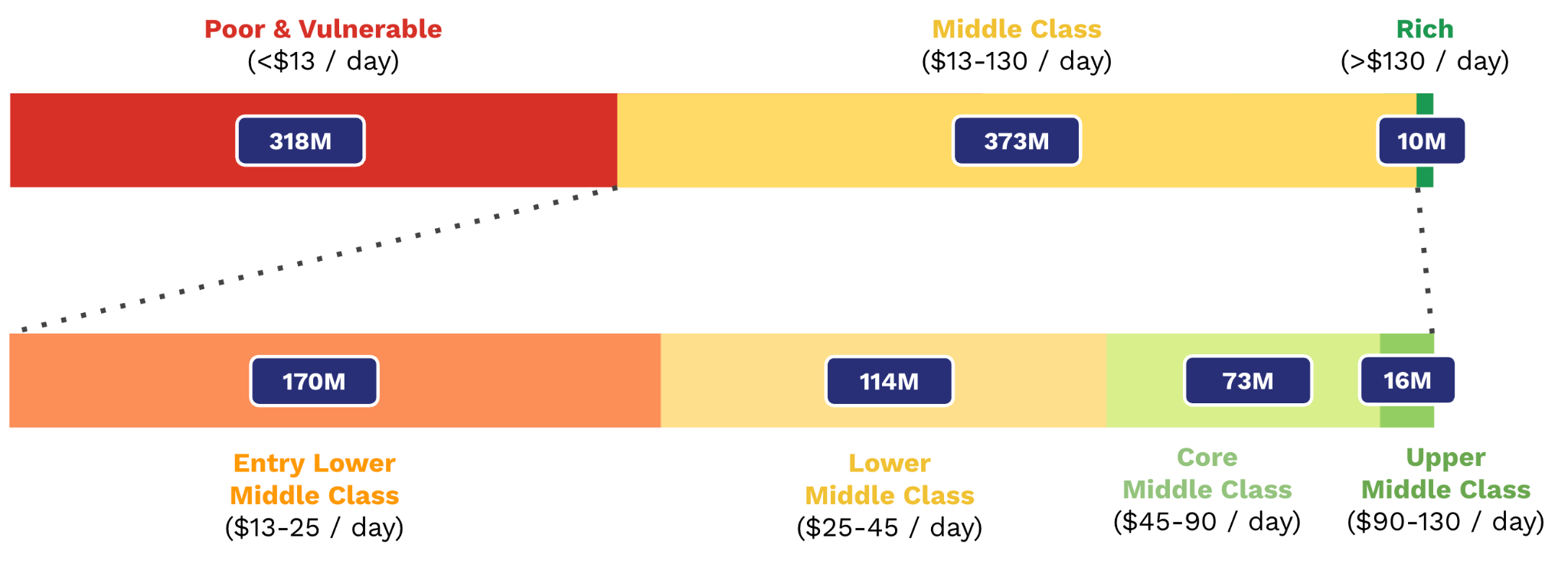
- Most of ASEAN's middle class is still just above the vulnerability threshold (i.e. 283M in the lower middle class spending $13-45 / day) - that's where the opportunity is.
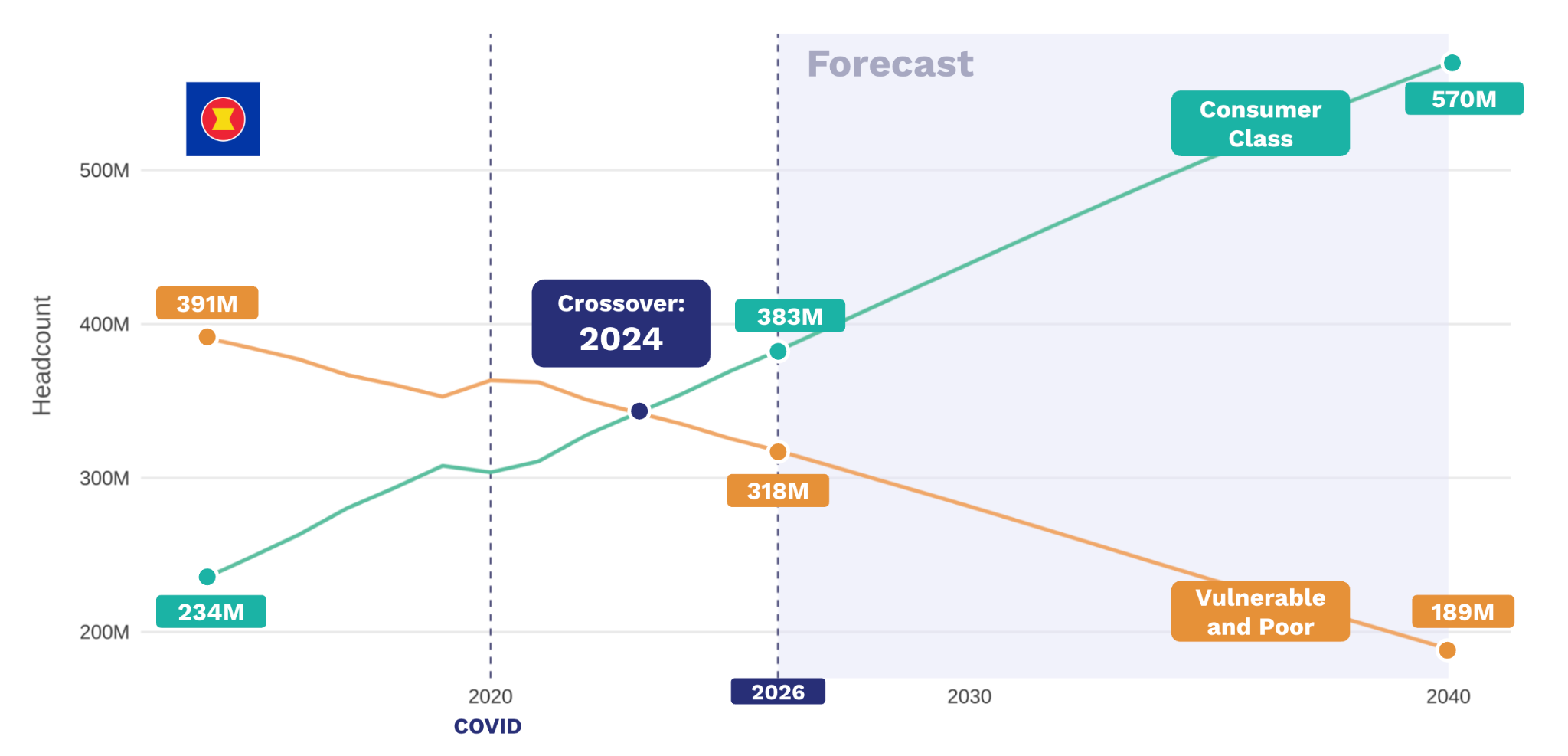
APAC's³ middle class is 2.6 billion people today, rising to 3.3 billion by 2036. ASEAN is an important part of that story: its middle class is 373m people strong and thus substantially larger than the entire population of the USA (350m) and EU's (450m). The middle class and rich together make up the consumer class (383M people comprising 373M middle class and 10M rich), which has been the majority in ASEAN since 2024 (see figure 1).
Source: World Data Intelligence, 2026
Of ASEAN's middle class, three quarters are still in the entry-level of the middle-class, spending $13–$45 a day (see Figure 2). These are people who can afford to buy a motorcycle, pay for a small amount of school fees and occasionally buy a merchant's shop some basic household goods.
Source: World Data Intelligence, 2026
They are not wealthy yet. As they sit just above the vulnerable threshold line, without much cushion for a major medical bill or a lost job.
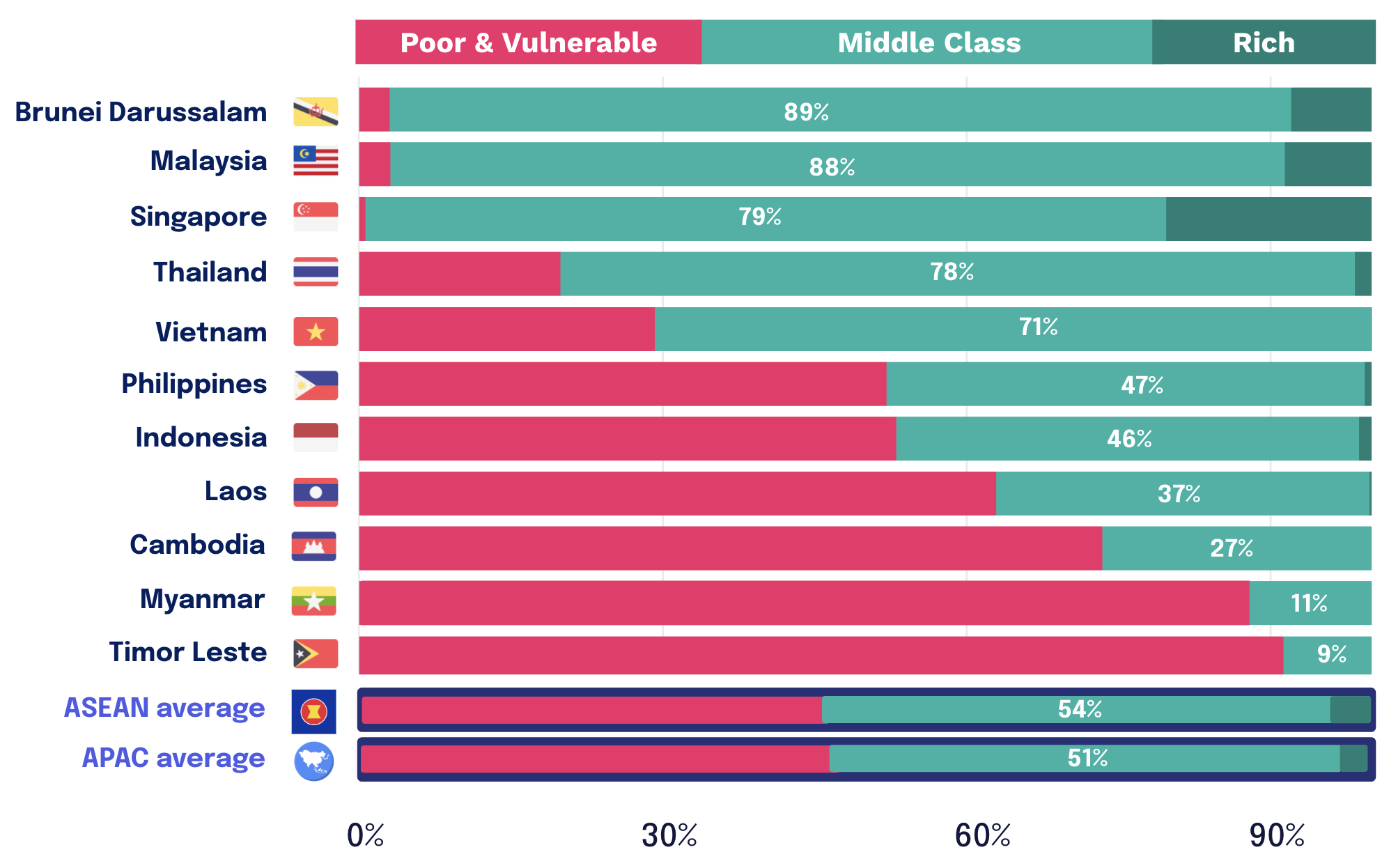
As a region, ASEAN is not homogenous with diverse economic characteristics, reflected in the size of the middle by country. ASEAN covers high-income economies like Singapore and Brunei, upper-middle-income economies like Indonesia, Vietnam and the Philippines, and lower-middle-income economies like Cambodia and Myanmar. Five ASEAN economies are already "middle class dominant": Brunei, Malaysia, Singapore, Thailand and Vietnam. Philippines and Indonesia will follow before the end of the decade.
Source: World Data Intelligence, 2026
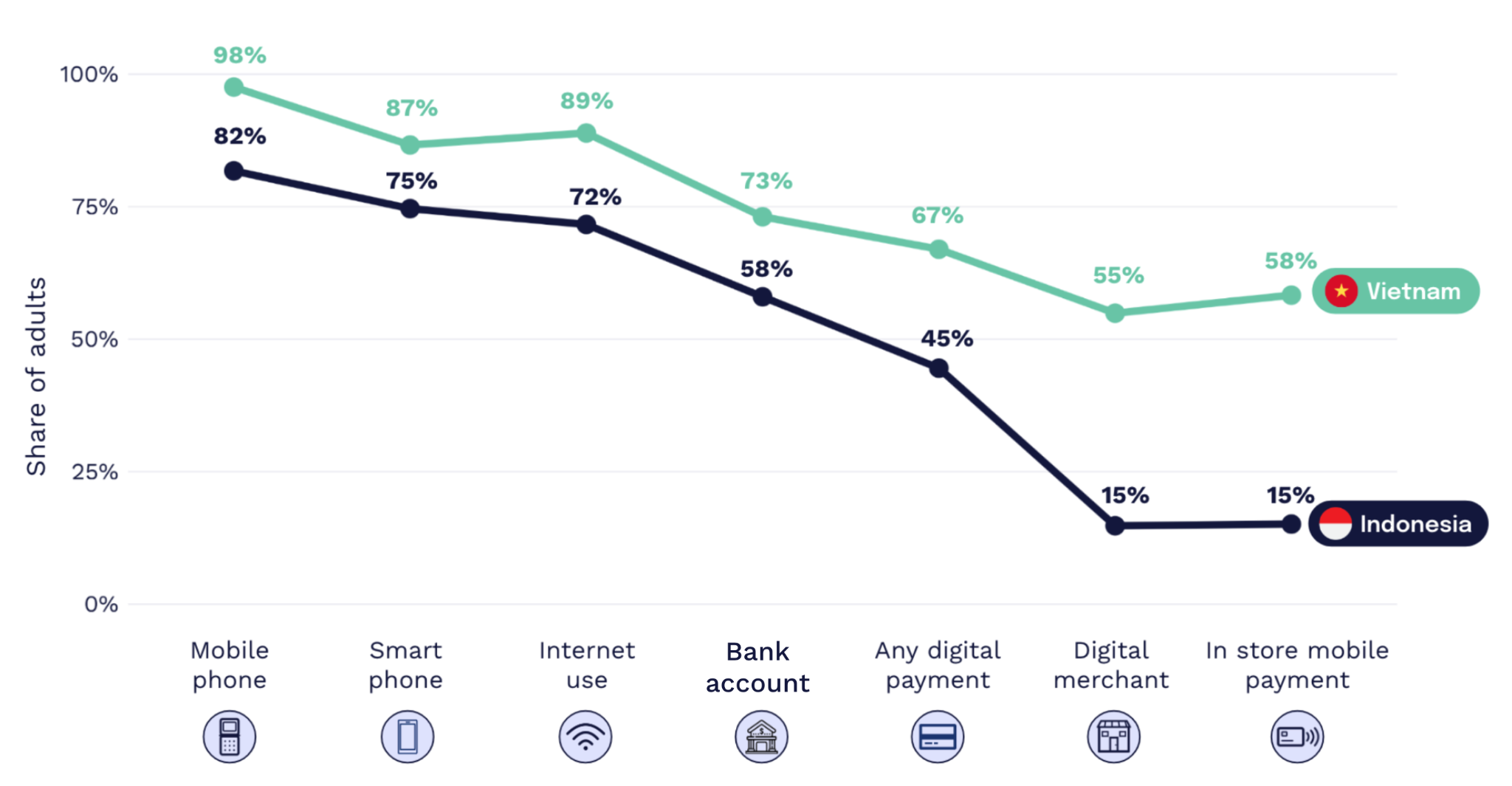
Across ASEAN, people have access to the internet and opening bank accounts faster (estimated at 348M in ASEAN currently) than using digital payments⁴. Indonesia and Vietnam show how different that gap can look. In Indonesia, 73% of adults use the internet, but only 45% pay digitally in stores. In Vietnam, the gap is smaller - 89% use the internet, and 67% pay digitally. Figure 4 (below) gives more detail on gaps in financial inclusion.
Source: World Data Intelligence, 2026
2. Indonesia
129M
2026 middle class
+54M
Middle class added by 2036
87M
Adults still unbanked, the largest pool in ASEAN
Key section takeaways
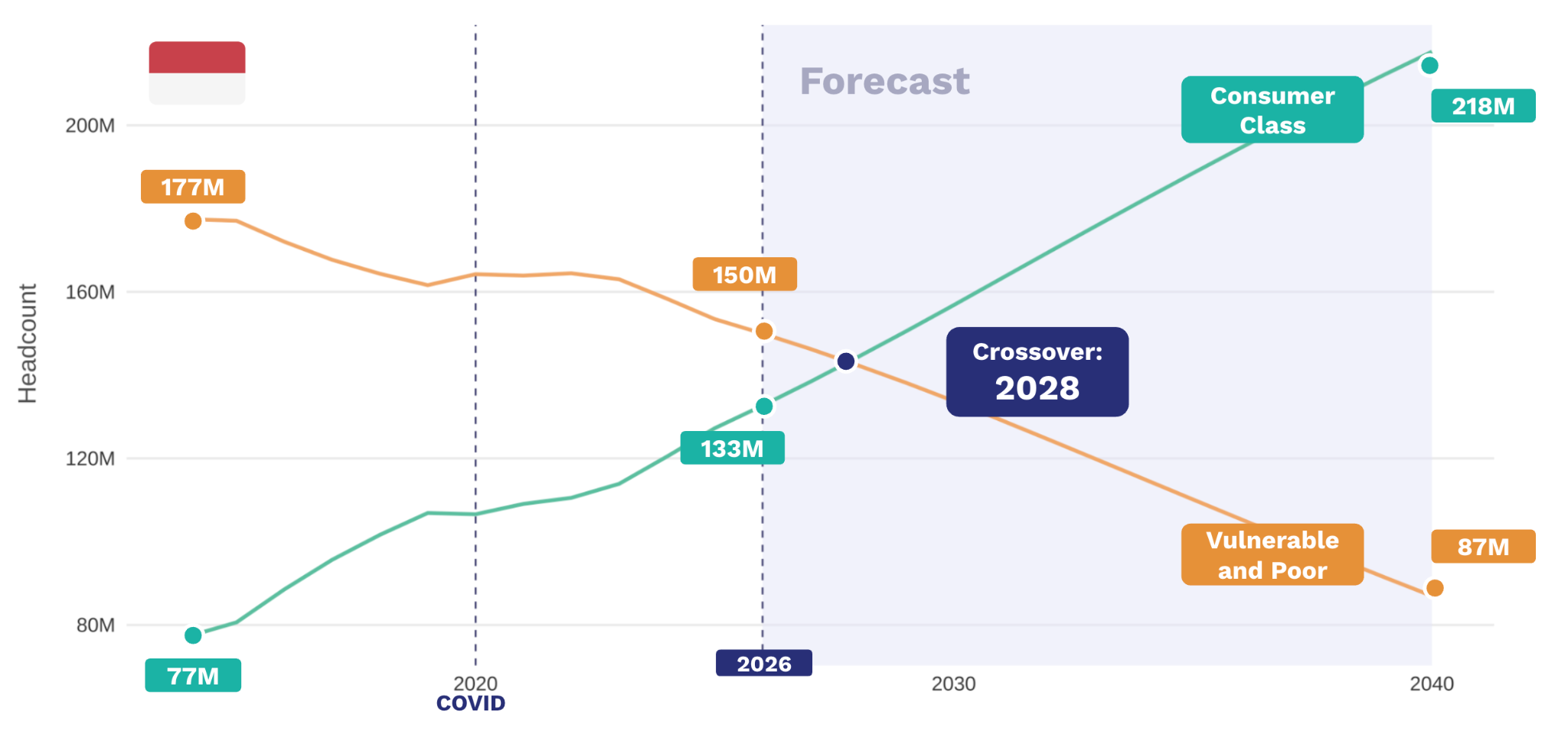
- Indonesia is the 4th largest middle class economy in the world after China, India and the USA. World Data Lab projects that Indonesia will have 100m middle class consumers in 2027.
- WDL projects that Indonesia will be a majority middle-class economy by 2029, reaching 183 million in the middle class by 2036.
- Smartphones have reached 75% of adults, but only 19% of them pay digitally in stores - a big gap between being online and actually using it.
- Business is the top reason Indonesians borrow, but most of that borrowing is still informal, not through a bank.
Indonesia accounts for 129 million of ASEAN's 373 million consumer-class (35%), more than any other member state. Between 2026 and 2036, ASEAN's middle class grows by 120 million, and Indonesia contributes almost half of that growth. As seen in Figure 5 below, It has just crossed the 100 million consumer mark, first in ASEAN and sixth in the world by consumer headcount.
Source: World Data Intelligence, 2026
In Indonesia, an account becomes common at just $3 a day of spending - one of the lowest thresholds in ASEAN. The challenge isn't access, it's use: plenty of Indonesians have a way in, but most still aren't using it day to day, as seen in Figure 4.
At 59%, account ownership in Indonesia sits below the ASEAN average (66%) and well behind Thailand (92%) and Malaysia (90%). At Indonesia's population size, that gap means about 87 million unbanked adults. Mobile money is the fastest-growing channel: from near zero in 2014 to 22% in 2024, projected to reach 45% by 2036.
One key thing to note is that Indonesians borrow for business. At 15% of adults, business is the largest single borrowing purpose, ahead of food and daily expenses (11%), health (10%) and education (7%). This is demand for growth credit, not distress credit. But most of it runs through informal channels: 32% of adults borrow informally against 13% formally.
3. Vietnam
71M
Middle class (out of 100M)
+44pp
Account ownership added in ten years
67%
Pay by card or mobile in stores, over 3x Indonesia
Key section takeaways
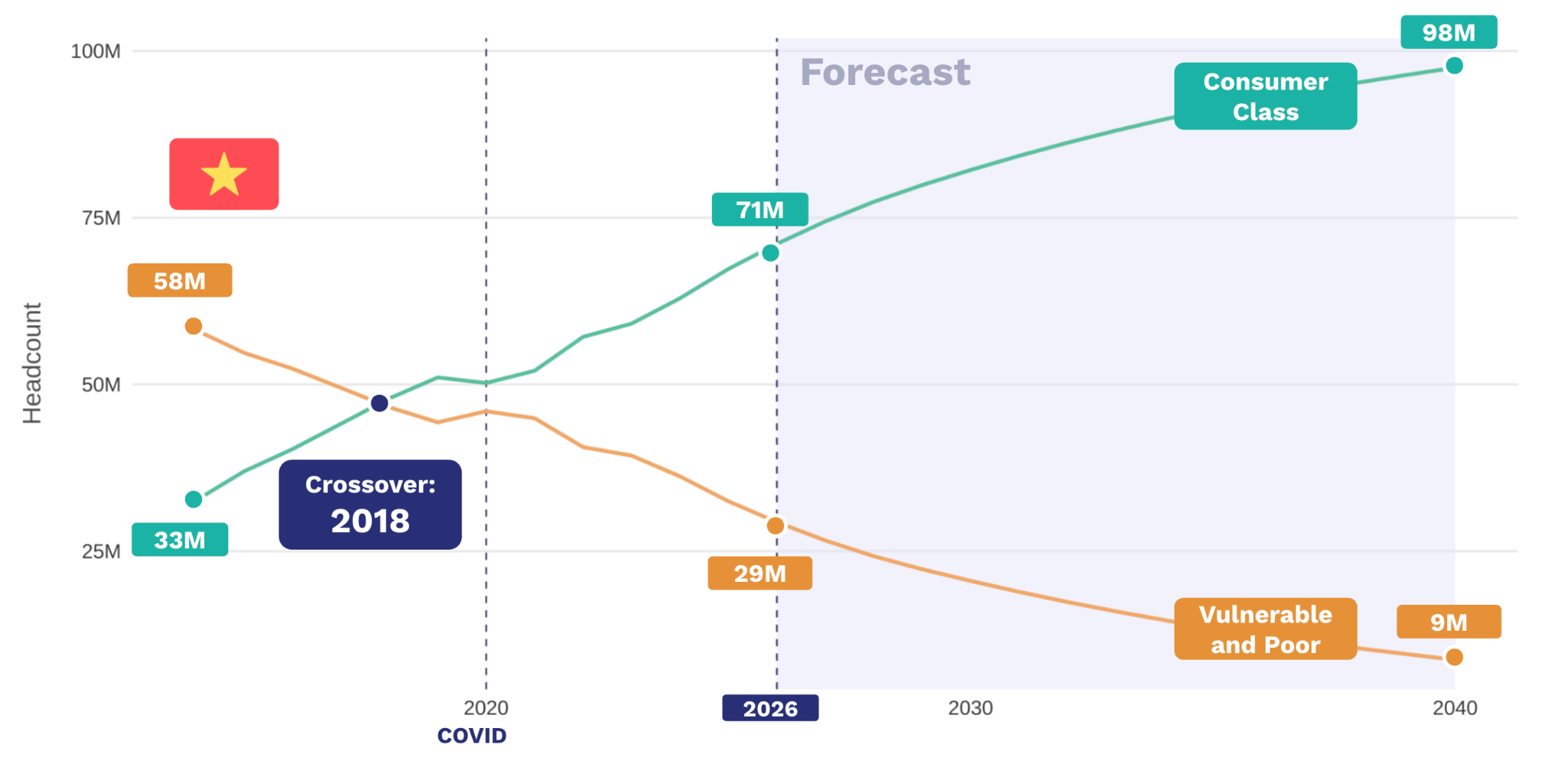
- Vietnam has the second largest middle class in ASEAN, at 71M (out of 100M total). It is also the second in ASEAN by growth, reaching 91M by 2036.
- Vietnam added 44 percentage points of account ownership in ten years - the fastest in ASEAN.
- 67% of adults now pay digitally in stores, more than three times Indonesia's rate.
- Even so, 44% of adults say medical costs are their biggest financial worry - Vietnam is banked and saving, but doesn't yet feel protected.
As seen in Figure 6, Vietnam crossed the 50% consumer-class threshold around 2018 and has been pulling away since. Today, 71 million of its 100 million adults (71%) belong to the middle class. By 2036 that reaches 91 million (87%), and the Vulnerable and Poor segment shrinks from 29 million to 12 million. Mass poverty ends inside the forecast window.
Source: World Data Intelligence, 2026
In Vietnam, an account becomes common at $4.20 a day of spending - close to the global average. Vietnam shows what happens once that threshold is crossed: people getting an account also tend to use it. The next step is protection - insurance and safety nets that could ease the medical-cost worry still holding people back. The data shows that 44% of adults name medical costs as their biggest financial worry, more than double the second-placed concern (monthly bills, 19%). People are banked, saving and paying digitally, but the buffers they have built do not feel sufficient against a large medical shock. Once usage is solved, protection becomes the gap.
4. What It Costs to Be Financially Healthy
Different financial services become common and accessible (i.e. where at least 30% of people have access) at different levels of daily spending (PPP), as seen below.
The main takeaways are:
- Access is cheap, resilience is expensive: an account costs just $3–4.20/day across the board, but a full month's expense buffer jumps to $15–18, and formal savings ($31 in Vietnam) sits far beyond that. The main gap isn't banking access, but building durable financial cushions.
- Indonesia consistently under-indexes vs. Vietnam and the ASEAN average on every milestone, meaning the same dollar of spending buys more financial security in Indonesia.
- Formal savings products are structurally underpenetrated in both focus markets relative to global norms, not just a behavioral gap.
- MCFIG-type interventions have the most room to move the needle in the "$8–18/day" band (emergency funds through one-month coverage), which is where ASEAN's next 120 million consumers are landing.
Reading the table: each cell is the daily spending level (PPP) at which at least 30% of people in that market clear the milestone. Lower numbers mean the milestone is reached earlier, i.e. more accessible relative to income.
| Indonesia | Vietnam | ASEAN | World | |
|---|---|---|---|---|
| Access to an account | $3 | $4.20 | $4.20 | $4 |
| Ability to raise emergency money | $8.30 | $14 | $10 | $12 |
| Not worried about paying bills | $10 | $16 | $13 | $18 |
| Can cover expenses for more than two weeks | $8.30 | $14 | $11 | $13 |
| Can cover expenses for more than one month | $15 | $17 | $18 | $29 |
| Savings | $18 | $19 | $21 | $28 |
| Formal savings | NA | $31 | NA | $74 |
Note: thresholds are calculated as the spending level at which at least 30% of the population reaches the indicator. NA means no spending group reaches 30%.
5. Conclusion
ASEAN is a diverse market. It includes high-income countries such as Singapore to lower-middle-income Cambodia and Myanmar, with Indonesia and Vietnam now both upper-middle-income. In this region, the middle class is dominant and growing. ASEAN's middle class is 373 million as of 2026 and will add another 120 million by 2036. Entering the middle class means gaining access to a range of consumer goods and financial services. Indonesia and Vietnam drive most of that growth, however they are at different stages of the financial health spectrum.
Indonesia has the users: 73% are connected to the internet, yet only 19% use a a digital payment in stores. The infrastructure exists; adoption doesn't. Vietnam has the adoption: 67% pay digitally, one of the highest rates in ASEAN. What it lacks is protection - 44% of adults cite medical costs as their top financial worry, more than double any other concern. The cost data explains why. A bank account is cheap to reach, $3–4 a day, but a one-month expense buffer costs $15–18, and formal savings costs more still. Most of ASEAN's next 120 million consumers will land in that gap between access and resilience.
Background to the partnership
WDL partnered with the Mastercard Center for Inclusive Growth to deepen data-driven insights on inclusive growth and financial health. The partnership brings together strengths in advanced data science, economic analysis and global convening to generate forward-looking insights on financial health and the evolution of the global middle class to anticipate where new opportunities and vulnerabilities will emerge and what they mean for economies, businesses and communities.
Authors:
- Wolfgang Fengler - Co-founder and CEO (World Data Lab)
- Reshma Sheoraj - Senior VP (World Data Lab)
- Tedi Yankov - Data Scientist (World Data Lab)
References
- ASEAN denotes Brunei, Cambodia, Indonesia, Laos, Malaysia, Myanmar, the Philippines, Singapore, Thailand, Timor-Leste, and Vietnam (Timor-Leste joined in 2025).
- We define 'Middle Class' as the part of the population spending between $13 and $130 a day. Those spending less than $13 / day are classified as 'Vulnerable and Poor' and those spending above $130 / day are classified as 'Rich'. We can segment further within these broader groups.
- APAC generally spans East Asia (e.g., China, Japan, South Korea, Taiwan, Hong Kong, Macau, Mongolia), South Asia (e.g., India, Pakistan, Bangladesh, Sri Lanka, Nepal, Bhutan), Southeast Asia (e.g. Indonesia, Vietnam, the Philippines), and Oceania (e.g., Australia, New Zealand, Papua New Guinea, and other Pacific Island nations).
- According to the World Bank, 'digital payments' are defined as using mobile money, a debit or credit card, or a mobile phone to receive a payment through an account in the past 12 months. It also includes receiving remittances, receiving payments for agricultural products, receiving government transfers, receiving wages, or receiving a public sector pension directly into a financial institution account or through a mobile money account.