blog · May 2026
Mexico Insights: Middle Class Growth and Financial Health
By World Data Lab
Mexico is the second-largest middle-class market in Latin America and the Caribbean, with 74 million middle-class consumers and a distinct financial health challenge.
Key Takeaways
- LAC has a 404 million-person middle class (out of 665 million), but upward mobility is slowing. Middle class growth is not keeping pace with other regions, and more than 100 million people in LAC remain just above the $13/day PPP middle-class threshold, leaving them at risk of falling back into vulnerability when faced with unexpected costs.
- Account ownership has risen, yet Mexico still lags peers in turning access into regular use of formal financial services. Smartphones (75%) and internet access (77%) are widespread, but digital payments (45%) and active account use (29%) remain much lower.
- Mexicans are saving more through formal channels (14% in 2024 vs 17% in 2014), but gains have been minimal and financial resilience remains weak. Many households still rely on informal credit and borrow for health expenses and consumption, suggesting savings are not enough to absorb shocks.
- Mexico has expanded account ownership, but progress has been driven more by rising incomes than by easier, cheaper access to financial services.
Mexico and LAC context
Today, around 404 million people across Latin America and the Caribbean (LAC), 61% of the region's population, spend between $13/day and $130/day PPP — making them part of LAC's middle class. Mexico has the second largest middle class in the region, with 74 million people (57% of the population, see figure 1). Although 61% of the total population represents a large middle class, growth is lagging behind other world regions, such as ASEAN. Between 2026 and 2036, LAC's middle class is projected to grow by 54 million people, while ASEAN is projected to add more than twice as many, growing by 117 million people (from 393 million to 510 million). ASEAN is expected to surpass LAC's 2026 middle-class size as early as 2027. Mexico and Vietnam illustrate the gap: both have similarly sized middle classes today (74 million in Mexico vs. 70 million in Vietnam), but Vietnam is projected to add 20 million middle-class consumers by 2036, compared with 11 million in Mexico.
LAC's middle class may be large, but more than 100 million people across LAC — roughly one in four middle-class households — remain between $13 and $20/day, just above the entry threshold, with little room to absorb a health bill, a lost job, or a climate shock. As a result, the financial inclusion agenda in LAC is shifting. Having an account is no longer the finish line: the question is whether that account is actually translating into financial resilience and the ability to absorb economic shock. In Mexico, account ownership has risen from 37% in 2014 to 53% in 2024, yet only 19% of Mexican adults can cover two months of expenses without hardship.
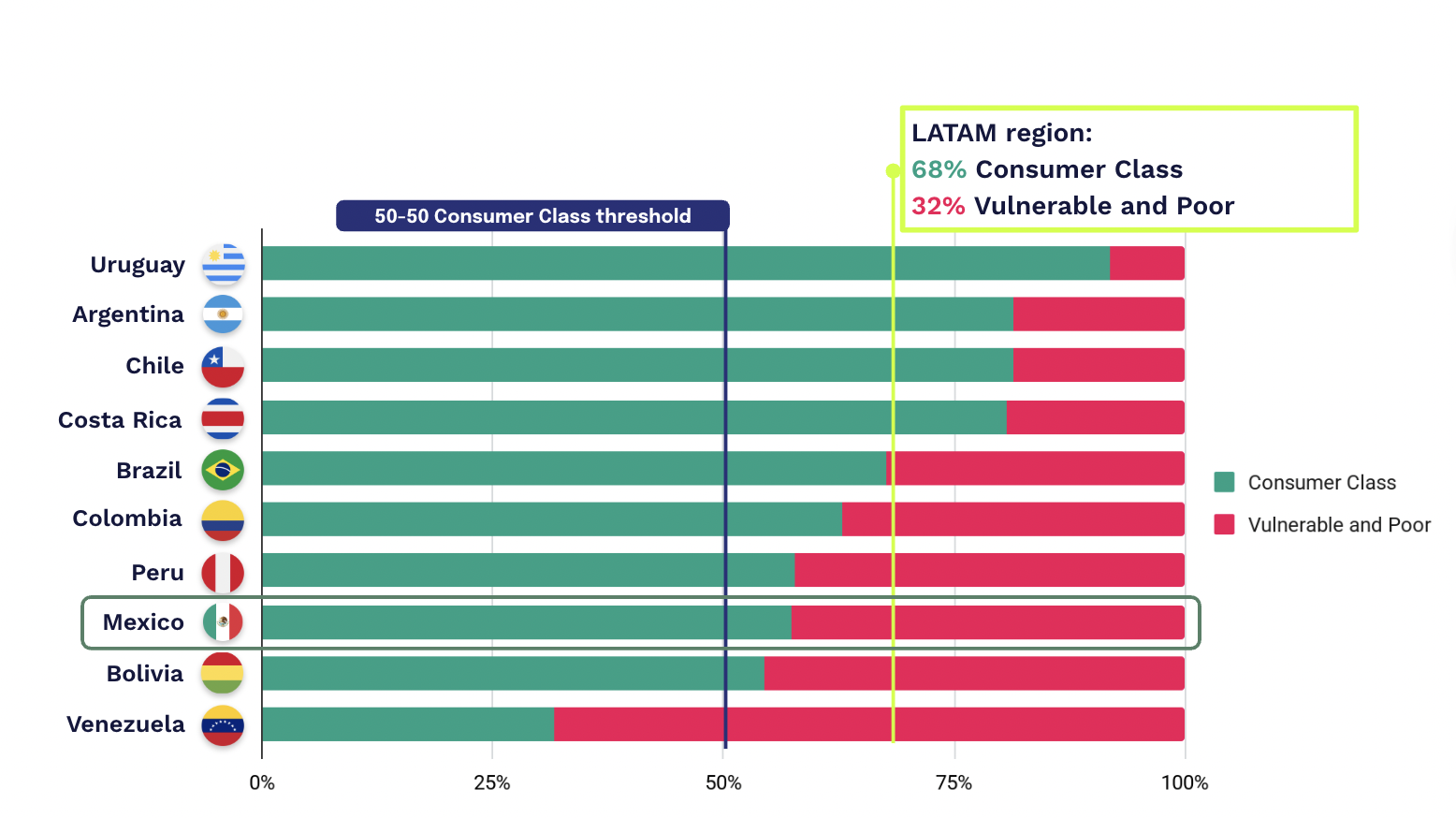
Source: World Data Lab. Numbers as of 2025. Consumer class defined as spending above $13/day 2021 PPP, comprising both the middle class and the rich.
Account Access and Usage
Two forces drive financial inclusion:
Mexico's gains have come almost entirely from rising incomes which leaves many opportunities for financial sector innovation. Conversely, Brazil's inclusion threshold sits at $8/day PPP; Chile's at $10. Both have had substantial gains from increasing access by lowering thresholds in the past decade. Mexico's threshold is $22, well above the LAC average of $14 (see figure 2), meaning that even households spending above the poverty line but below $22/day remain largely outside the formal financial system.
The structural access barrier means that millions of Mexicans who have crossed out of poverty still cannot meaningfully participate in the formal financial system. Within the country, account ownership differs by more than 30 percentage points between the lowest and highest income groups. Adults over 65 are the least likely both to hold accounts and to actually use them. Millions of new accounts have been opened over the past decade, but usage is not following suit.
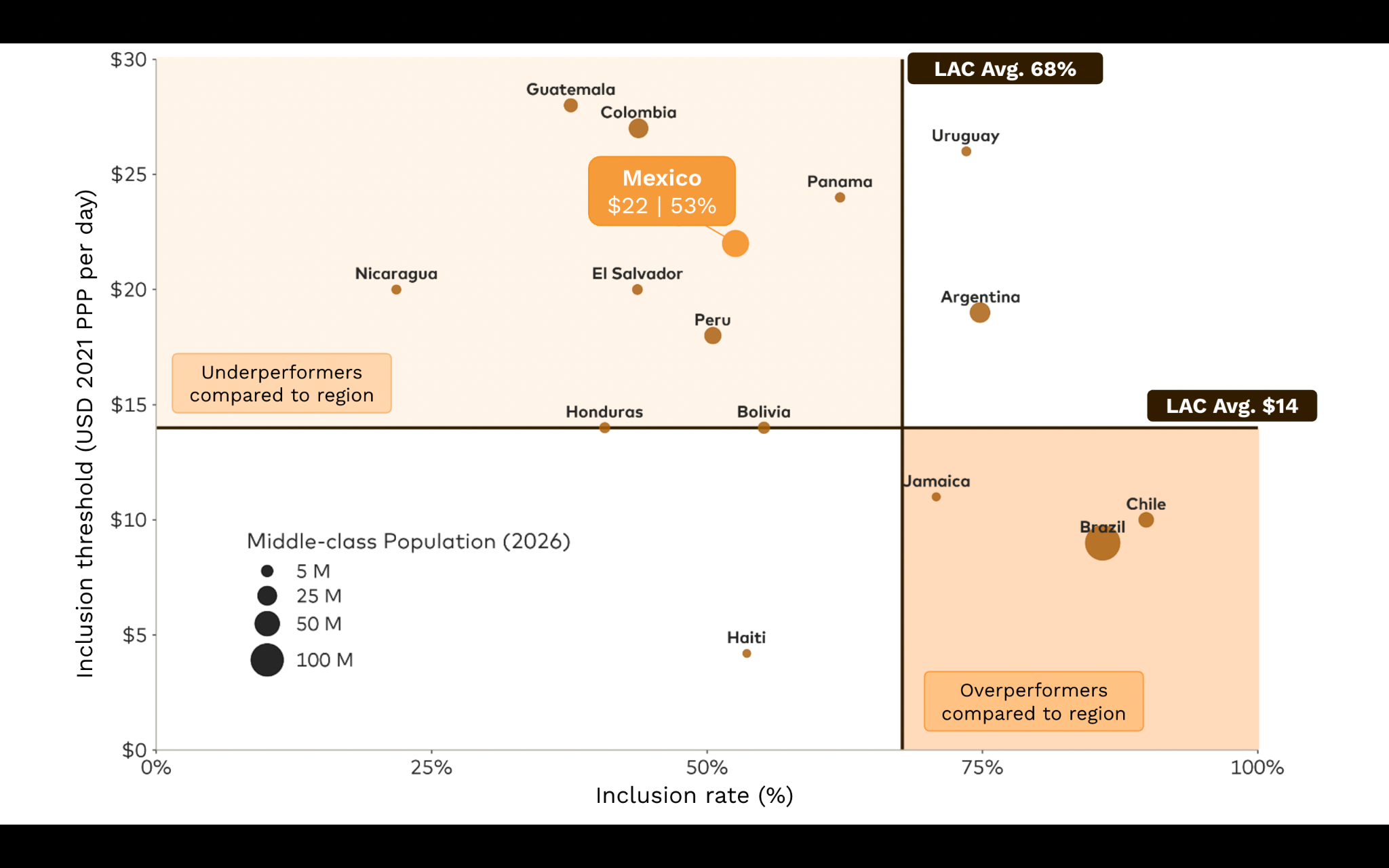
Source: Inclusion thresholds estimated by combining World Bank Findex survey data with World Data Lab's granular spending model.
Digital Payments vs. Cash
Holding an account is a necessary starting point, but what matters for financial health is whether people actually use it to build savings and establish a financial track record. In Mexico, the gap between account ownership and active digital use is one of the widest in the region, and savings at a financial institution remain quite low at 17%.
Roughly 8 percentage points separate account holders from active digital payment users: a gap that widens further at each step down the payment funnel. Fewer than one in five Mexican adults used a card or mobile payment in a physical store in 2024. Smartphone ownership (75%) and internet use (77%) are both significantly higher than digital payment adoption (45%), pointing to a product design and trust problem rather than a connectivity one.
The gap is sharpest where it matters most for government disbursement programmes. Older adults receive government transfers at higher rates than any other age group, yet are the least likely to use digital payments.
Financial Health
There is one genuinely encouraging signal: formal saving rates in Mexico roughly doubled from 12% to 23% between 2021 and 2024, according to World Data Lab's analysis of Findex. When Mexicans are connected to the formal system, they do use it to save. The data also show, however, that Mexicans borrow for health expenses and purchases at higher rates than the LAC average, indicating that those savings may be insufficient for financial resilience.
Informal credit (17%) dwarfs formal credit (6%): a 3:1 ratio that signals a structural failure of formal financial products to reach working Mexicans. Among borrowing purposes, health expenses (16%) and consumer purchases (15%) dominate (see figure 3). Business borrowing sits at just 5%, signaling not growth-oriented entrepreneurial credit, but households using debt to absorb shocks that savings should be covering.
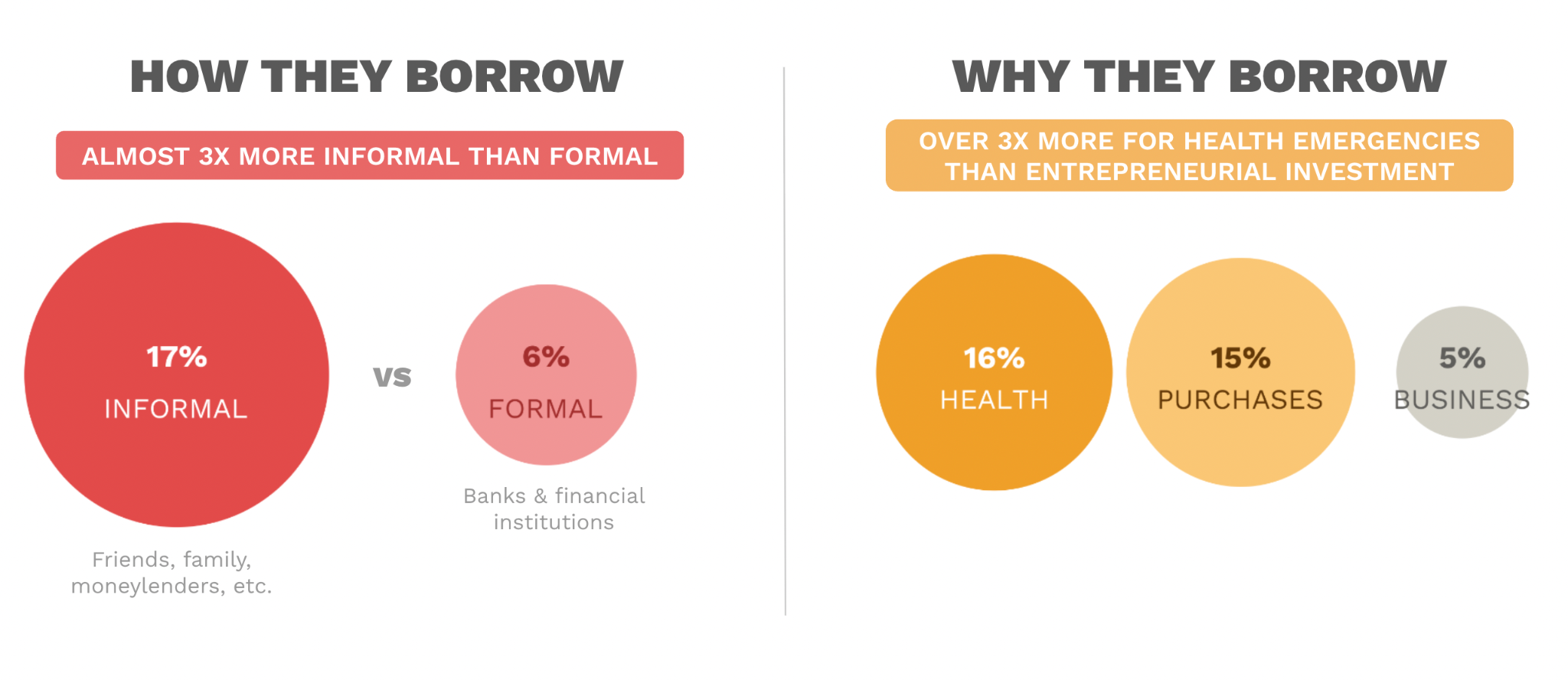
Source: World Bank Global Findex 2024; World Data Intelligence (WDI), World Data Lab analysis.
Note: Findex figures refer to adults 15+. Financial health defined as ability to cover expenses for 2+ months without hardship.
References
- Income effect: The number of people who gained access to financial services primarily because their income increased — typically as a result of broader economic growth.
- Threshold effect: The number of people who became financially included mainly because financial services became more accessible to lower-income groups — for example, through reduced costs or simplified products.