blog · September 2, 2026
Africa's youth employment paradox: More educated but not employed?
By Ivy Nyayieka
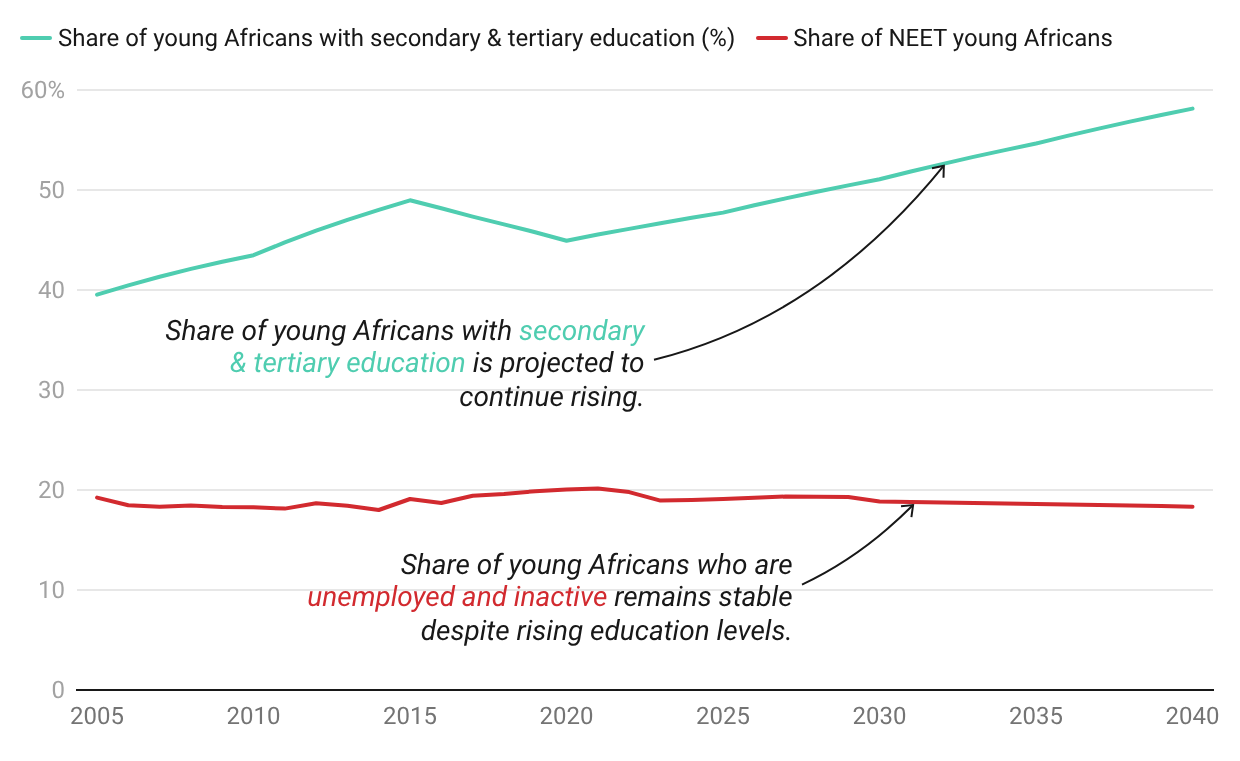
Africa's youth population is expanding by about 217 million between 2025 and 2040 and becoming more educated, yet job creation is not keeping pace, leaving millions of young people educated but unemployed.
Africa's youth population (ages 15-35) is set to rise by about 217 million between 2025 and 2040. The young people are becoming increasingly educated across all levels: the share of young people with less than primary education is projected to fall from about 32% in 2025 to about 23% by 2040, while that of those completing secondary education, is projected to rise from about 38% to about 45%, and tertiary graduates from about 9% to about 13%. However, job creation is not keeping pace. Employment is projected to increase only slightly from about 57% to about 58% between 2025 and 2040, leaving about 85 million more young Africans with at least a primary education who are Not in Employment, Education or Training (NEET).
Global research shows that higher education generally improves employment prospects and leads to higher wages, and that NEET rates decline as education levels rise.¹ ² However, in much of Africa, this pattern is weaker due to slow formal job growth and a mismatch between education and labor market demand, where graduates often lack practical skills for available positions.³ While educational attainment is steadily improving, Africa's economies generate only about 3 million formal jobs for the over 10 million youth entering the labor market each year, according to a recent report co-authored by the World Data Lab in partnership with the Mastercard Foundation and the University of Cape Town's Development Policy Research Unit. At first glance, young Africans appear highly engaged, with 57% employed compared to 48% in the rest of the world. However, this gap exists largely because a significantly smaller share of African youth are students (24% versus 31% in the rest of the world). This premature leap into the labor market is stark among youth of school-going age (15-17 years): in 2025, 42 million young Africans in that adolescent demographic were already working, compared to just 33 million who were studying. An overwhelming 96% of these working school-aged youth are employed in informal jobs, with more than half driven into agriculture, a sector typically linked to lower earnings, leaving 40% living below the extreme poverty line of $2.15 a day (2017 PPP). Even as more youth are projected to remain in classrooms over the coming decades, these academic gains are not expected to translate into improved employment outcomes, with the share of NEET youth projected to remain stable at about 19% through 2040.
While education levels are projected to rise, the limited employment payoff points to a deeper challenge on both the supply and demand sides of the labor market: persistent skill and educational mismatches and slow formal job creation. Evidence from 10 African countries⁴ shows that among employed youth, 8% are overeducated, 18% overskilled, 29% underskilled, and 57% undereducated. Over-skilling and over-education are linked to average wage penalties of 7% and 18%, respectively.⁵ ILO research shows that while expanding access to quality education remains essential, economic growth has not generated enough decent job opportunities, leaving graduates from post-secondary and tertiary education struggling to find jobs that match their qualifications and aspirations.⁶ The mismatch, driven in part by insufficient training and weak job creation systems, reduces job satisfaction and hinders young Africans from translating education into dignified work.
Young Africans with tertiary education have the second highest NEET levels at 24%. The unemployment rate of 13% at the tertiary level is the highest across education levels, showing that young university-educated Africans are seeking jobs but not getting them. In Ghana and Nigeria, for instance, young Africans who have finished university are more likely to report being discouraged as the reason they are out of work and school, than those with lower levels of education.
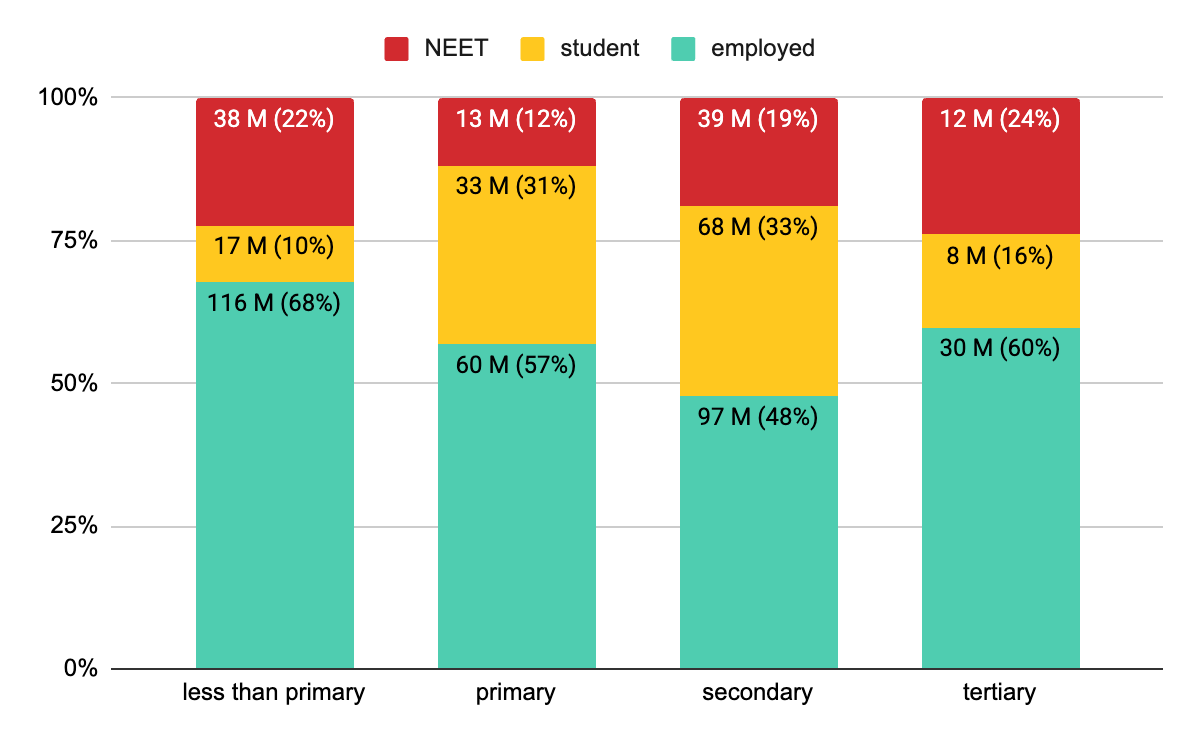
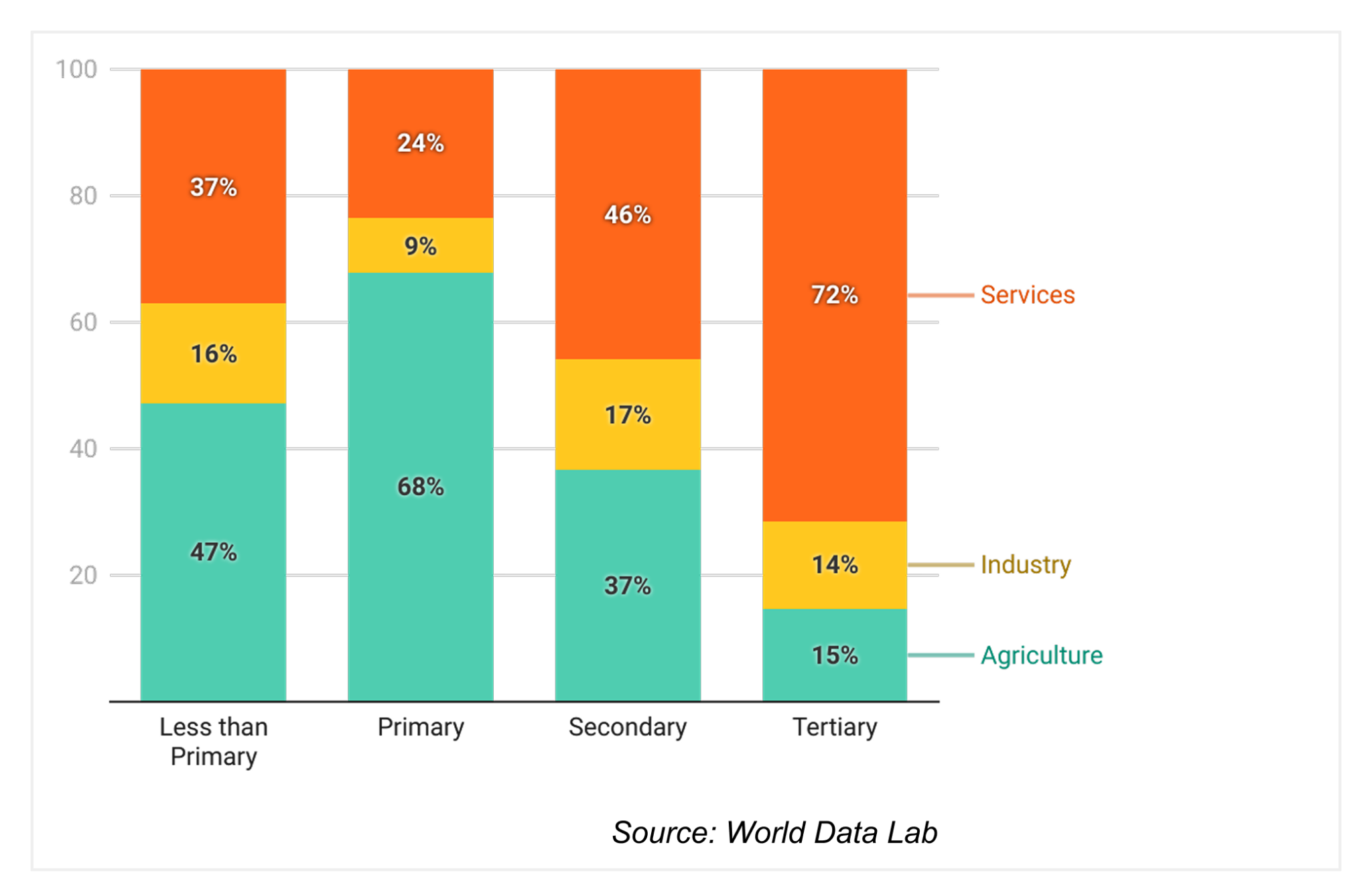
The increase in education attainment positions young Africans for the continent's future economy as services, a sector which draws in youth with secondary and tertiary education, is projected to expand 1.7 times between 2025 and 2040 and become the primary youth employer by 2033. Secondary and tertiary education attainment among youth in Africa is projected to grow 11 percentage points to 58% between 2025 and 2040. An analysis by World Data Lab shows that service and industry jobs tend to pay more than agriculture with young people in services earning about 2.6 times more than those in agriculture.
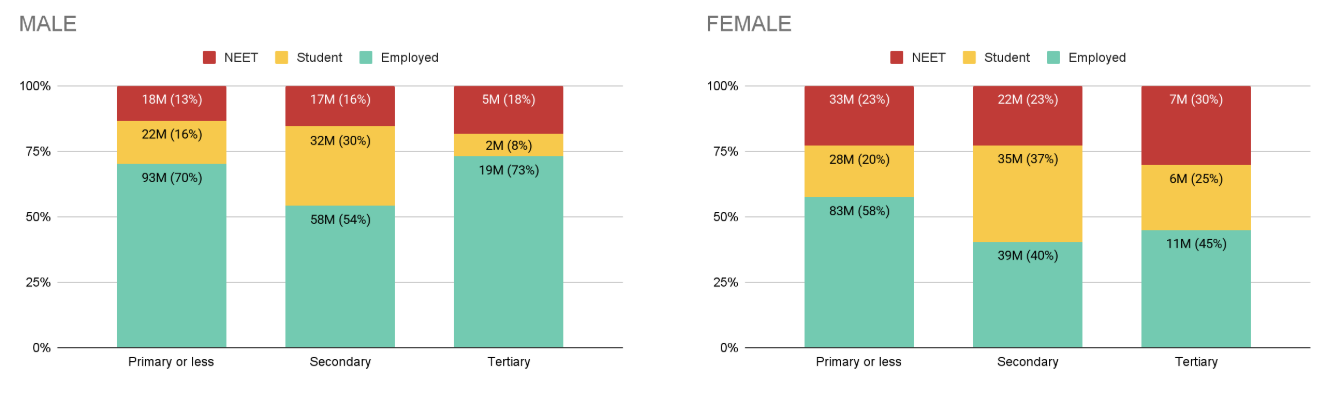
Even as both young men and women become more educated, young women continue to face far weaker employment outcomes, including at the same education level, making up nearly 61% of all NEET youth in 2025, reflecting barriers such as caregiving responsibilities, limited job access, and social norms that restrict women's participation in the labor force. In 2025, for example, young women with secondary education are far less likely to be employed (49%) than young men with the same education level (60%). For tertiary graduates, the gap widens further: 81% of young men with tertiary education are employed, compared to 57% of young women. Young women with less than a primary education have a 19% NEET rate, compared to 11% of young men of the same level.
This data highlights a significant opportunity for future economic growth as educational investments yield better returns, with an analysis in the Africa Youth Employment Outlook 2026 report estimating that achieving gender parity in youth NEET rates could bring 15 million more young women into employment, adding $172 billion to the African economy. Employment among young women with tertiary education is projected to rise slightly from about 57% in 2025 to about 61% by 2040, driving their NEET rate to decline from about 43% in 2025 to about 39% by about 2040. Among young men, tertiary NEET rates are projected to fall from about 19% in 2025 to about 16% by 2040. Beyond reducing NEET rates, expanding education presents a pathway to decreasing gender wage disparities, as evidenced in Rwanda where women's average daily income jumps from $0.98 with less than primary schooling to $7.28 at the tertiary level. The projected declines in NEET rates and the income dividend show education could be a powerful tool for improving employment outcomes.
Closing Africa's education–employment gap
Africa's youth are becoming more educated, but employment shares are not keeping pace, creating a clear mismatch where, for instance, in North African countries like Algeria, Egypt, and Morocco, around 30% of young people with tertiary education are currently unemployed or inactive. However, rising educational attainment, with the continent's share of tertiary-educated youth projected to reach 13% by 2040, is evidence there is room for policymakers to proactively align training with the needs of expanding sectors. For example, Morocco's $450 million Employability and Land Compact is rehabilitating 15 TVET centers across the country, an investment which aligns skills with private-sector demand in fields such as logistics and health services, and is projected to benefit more than 800,000 Moroccans over 20 years. Beyond education reform, decision-makers must also expand opportunities in high-growth sectors that can productively absorb these skilled workers, as demonstrated by Ethiopia's urban infrastructure program that financed 2,700 kilometers of roads to successfully create 1.15 million jobs, with women filling nearly half of these roles.
References
- 1. International Labour Office. (2020). Global employment trends for youth 2020: Technology and the future of jobs. ilo.org
- 2. Arias, O., Evans, D. K., & Santos, I. (2019). The skills balancing act in Sub-Saharan Africa: Investing in skills for productivity, inclusivity, and adaptability (Africa Development Forum series). World Bank. doi.org/10.1596/978-1-4648-1149-4
- 3. Filmer, D., & Fox, L. (2014). Youth employment in Sub-Saharan Africa (Africa Development Series). World Bank. doi.org/10.1596/978-1-4648-0107-5
- 4. The 10 African countries analyzed in the study are Benin, Congo, Egypt, Liberia, Madagascar, Malawi, Tanzania, Togo, Uganda, and Zambia.
- 5. Morsy, Hanan, and Adamon N. Mukasa. Youth Jobs, Skill and Educational Mismatches in Africa. African Development Bank Group, Working Paper No. 326, July 2019.
- 6. International Labour Organization. Skills: State of Africa. ILO, 2020.