blog · May 18, 2026
ASEAN Insights: Middle Class Growth and Financial Health
By World Data Lab
ASEAN's middle class is already one of the world's most important growth stories, with 393 million people today and a further 117 million expected by 2036.
Key Takeaways
- Asia-Pacific is home to a 2.4 billion-person middle class (58% of the regional population), projected to reach 3.1 billion by 2036. ASEAN accounts for 393 million of that total today — 16% of Asia-Pacific's middle class and 56% of ASEAN's own population.
- Growth is broad but uneven across the bloc. Indonesia, Vietnam, and the Philippines are among the fastest-growing middle-class markets globally; Indonesia and the Philippines are projected to become majority middle class by 2032; Malaysia is already at 88%.
- More than 300 million ASEAN citizens still sit in the lower middle class ($13–$45/day), just above the entry threshold. The inclusion threshold in ASEAN is roughly $5/day, with 54 million adults below it in 2026, projected to fall to 32 million by 2036 — almost halving in a decade.
- Active use lags access. Smartphone ownership (85%) and internet use (83%) outpace digital-payment adoption (77%) and in-store digital use (62%). Formal saving rose from 23% (2014) to 28% (2024), but informal credit (33%) still runs at roughly 3× formal credit (11%), and health borrowing (14%) outweighs business borrowing (12%).
1. A Region Driving the Next Wave of Inclusive Growth
Southeast Asia sits at the center of a profound global economic shift. As the world adds millions to the consumer class each year, Asia-Pacific is driving nearly all of the net growth. Today, around 2.4 billion people across Asia-Pacific — 58% of the regional population — spend between $13/day and $130/day PPP, placing them in the middle class. That base is projected to reach 3.1 billion by 2036.
ASEAN is at the heart of this expansion. Its 393 million-person middle class represents 16% of Asia-Pacific's middle class and 56% of ASEAN's own population. Between 2026 and 2036, ASEAN is projected to add 117 middle-class consumers (compared to 122M added by China and 400M added by India).
2. Growth Is Broad, but Uneven Across Countries
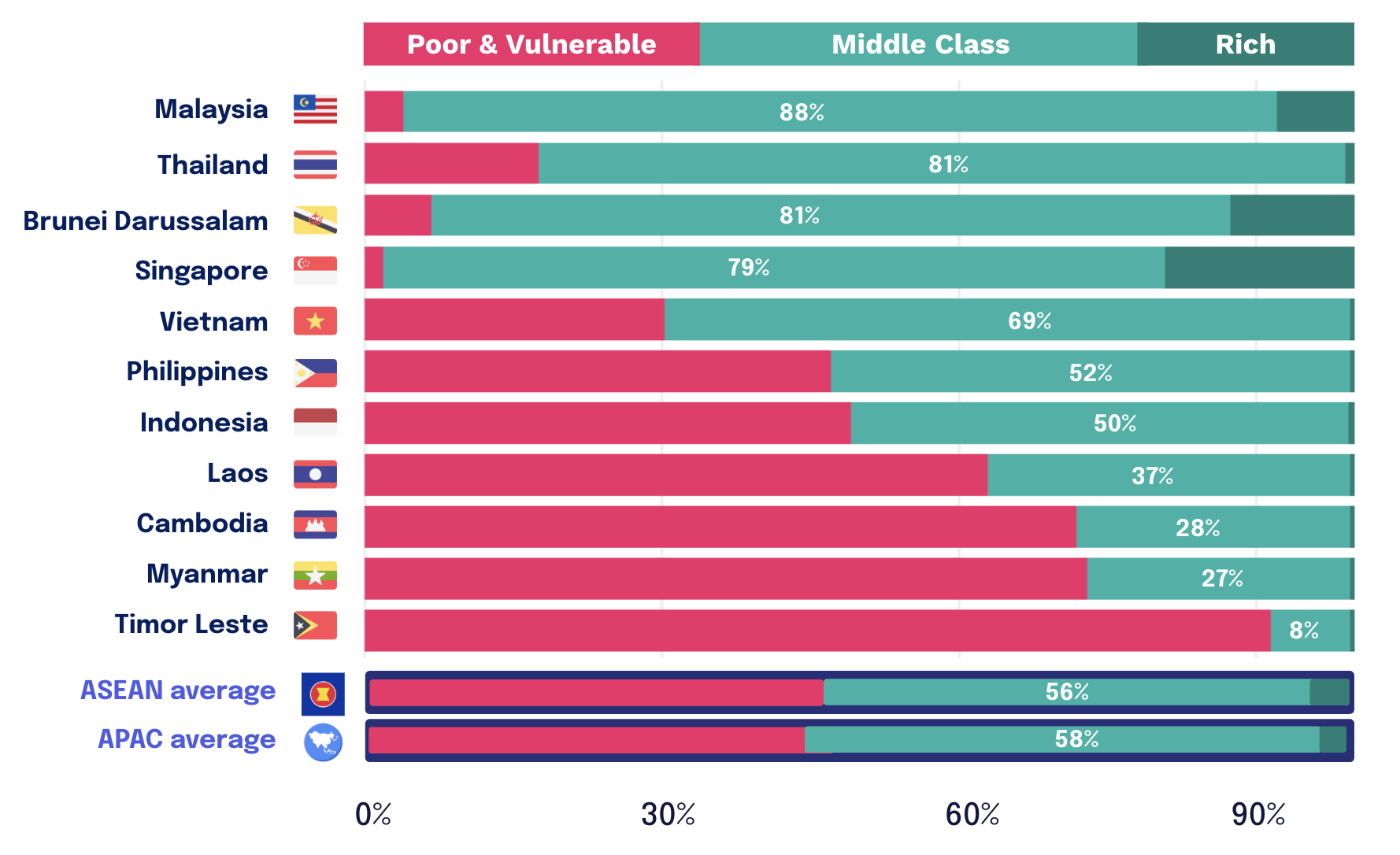
ASEAN's middle-class expansion is rapid but uneven (see figure 1). Indonesia, Vietnam, and the Philippines are among the fastest-growing middle-class markets globally and drive most of the region's momentum. Indonesia and the Philippines are projected to become majority middle class by 2032 — a key structural shift that will reshape consumer markets, financial-sector demand, and policy priorities across the bloc. Malaysia stands out at the other end of the curve: 88% of its population is already in the middle class, and the country is nearing full middle-class dominance.
3. The Middle Class as the Gateway to Financial Health
ASEAN's middle class may be large, but more than 300 million people remain in the lower middle class, between $13 and $45/day — just above the entry threshold, with little room to absorb a health bill, a lost job, or a climate shock. The rise of the middle class is more than an income story; it is a financial-health story. Crossing into the middle class represents a tipping point where households begin to participate in formal financial systems, build resilience against shocks, and transition from subsistence to choice-driven consumption.
Evidence from Findex suggests financial behaviours evolve in predictable stages as incomes rise. In ASEAN, financial inclusion begins at roughly $5/day, a formal bank account at $6/day, formal credit at $16/day, and credit-card access at $30/day. The encouraging news is that the number of adults below the inclusion line is shrinking quickly: from 54 million adults aged 15+ in 2026 to 32 million by 2036 — almost halving over the decade.
| Indicator | Threshold |
|---|---|
| Financial inclusion | ~$5 / day |
| Formal Bank account | ~$6 / day |
| Formal credit | ~$16 / day |
| Credit card | ~$30 / day |
Source: World Bank Global Findex 2024; World Data Intelligence (WDI), World Data Lab analysis.
Three forces drive financial inclusion:
- Rising incomes pull households across the threshold at which formal services become accessible (the income effect).
- Product innovation pushes that threshold down, so lower-income households do not have to wait for income growth to gain access (the threshold effect).
- A middle-class inclusion effect, where people already above the income threshold finally become included after having been excluded for non-income reasons.
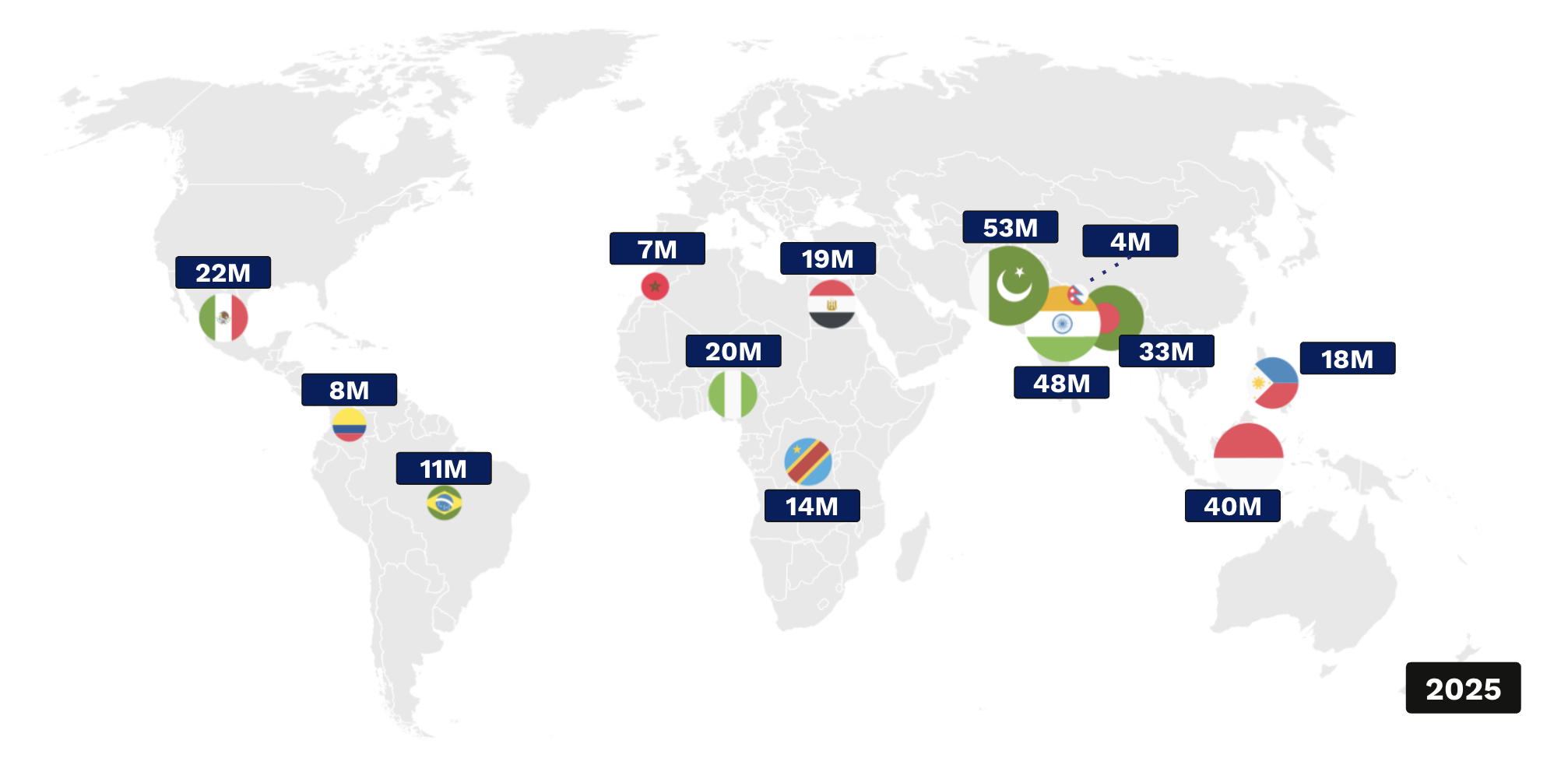
Even so, Asia-Pacific and ASEAN remain home to the world's deepest pockets of financial exclusion. Around one in three financially excluded adults globally live in just five Asian countries — two of which, Indonesia and the Philippines, are in ASEAN (see figure 2). Closing that gap will require both income growth and deliberate product innovation aimed at the households just above the inclusion threshold.
Holding an account is a necessary starting point, but what matters for financial health is whether people actually use it to build savings and establish a financial track record. In ASEAN, the gap between holding an account and saving formally is 11 percentage points, and that gap widens at each step further down the payment funnel. In 2024, 62% of ASEAN adults used a card or mobile payment in a physical store. Smartphone ownership (85%) and internet use (83%) are both higher than digital-payment adoption (77%), pointing to a product-design and trust problem rather than a connectivity one — the infrastructure is largely in place; behaviour change is still catching up.
There is a genuinely encouraging signal on savings: ASEAN's formal saving rate rose from 23% in 2014 to 28% in 2024. When ASEAN households are connected to the formal system, they do use it to save. But informal credit (33%) still dwarfs formal credit (11%) — a roughly 3:1 ratio that signals a structural failure of formal financial products to reach working ASEAN households. Among borrowing purposes, health expenses (14%) outweigh business borrowing (12%), pointing not to growth-oriented entrepreneurial credit, but to households using debt to absorb shocks that savings and insurance should be covering.
5. From Access to Outcomes: The Next Frontier
ASEAN illustrates a broader shift in the global inclusion agenda — from expanding access to delivering meaningful outcomes. Access to accounts, payments, and credit has improved significantly across the region; the challenge now is to ensure these tools translate into day-to-day financial stability, the capacity to absorb shocks, and long-term wealth-building. Insurance adoption emerges as a critical next milestone — the signal that households have moved beyond basic survival toward forward-looking financial planning.
6. Why This Moment Matters
ASEAN's trajectory represents a rare convergence of opportunity and urgency:
- Scale: Hundreds of millions entering the middle class
- Speed: Faster growth than major global peers post-2032
- Impact: A generation defining future consumption, savings, and digital financial behaviors
Yet the region also highlights the central challenge of inclusive growth: How to ensure that rising incomes translate into resilient, financially healthy lives, and not just increased consumption.
7. Implications for Action
To unlock ASEAN's full potential, interventions need to focus on bridging the gap between access and resilience:
- Design for progression: Meet consumers at different income thresholds with tailored financial products
- Expand risk protection: Accelerate access to insurance and safety nets
- Strengthen financial ecosystems: Enable seamless transitions from informal to formal financial systems
- Target emerging consumers: Especially in high-growth markets like Indonesia, Vietnam, and the Philippines